Written and Reported By shams
A rare refuge threatened by industrial expansion.
In the heart of Korangi’s industrial sprawl, the Mangrove Biodiversity Park stands out as one of the few remaining natural spaces. The project, funded by TPL Developments in collaboration with the Sindh Forest Department, was inaugurated in late September by City Mayor Murtaza Wahab and is home to a number of native species.
The park and its waters were reasonably clean, especially given their proximity to the industrial areas of Korangi. Nevertheless, traces of plastic waste were still noticeable here and there.“We plan to construct a mesh/net which will trap plastic waste coming from the industrial area, which will then be removed from the water and disposed of properly” said Zahra Hirji, the Park Curator, while discussing future initiatives to maintain the park. “We also plan to introduce a form of technology that will help soak up the layer of oil present on the mud and in the water,” she added. Proper waste disposal arrangements were in place to ensure cleanliness of the park. “The trash comes from the water in the Korangi industrial area, visitors never litter in the park,” insisted Jahansher, the temporary park ranger.
According to a report published by the World Wildlife Fund, the destruction of mangrove forests is visible across the city’s coastal belt through satellite images, which show that 200 hectares of mangroves have been lost between 2010 to 2022. Rampant water pollution and lack of proper waste management have further contaminated the natural ecosystems in the city. “The effluent pouring out of our city needs to be treated. The sewage treatment plants need to be activated and new ones made. The deposits in the intertidal lands are extremely toxic both with chemical and organic discharge. This affects the mangroves and especially fish, shrimp, clams, all marine life as well as us as consumers,” said Tariq Alexander Qaiser, environmentalist and design consultant for the park. “Sewage treatment and waste management for our cities is critical. And needs to be enforced”.
This urgency was seconded by Shah Murad Aliani, the chair of the independent advisory board of the Mangrove Biodiversity Park and former country representative for IUCN, Pakistan. “Essentially the most critical aspect is conservation/protection and water remediation. Water remediation is very important to lessen the stress of effluents that are discharged upstream. We are already involved in clearing of the solid waste that comes downstream and intend to install trash booms in the first phase. In phase two, we will work actively on water quality,” he said while discussing measures to maintain the health of the mangroves. As part of his Environmental, Social and Governance advisory, Aliani recommended the formation of this biodiversity park in partnership with the legal custodians of all Mangrove forests, SFD. After this, he jointly developed the park with TPL Developments.
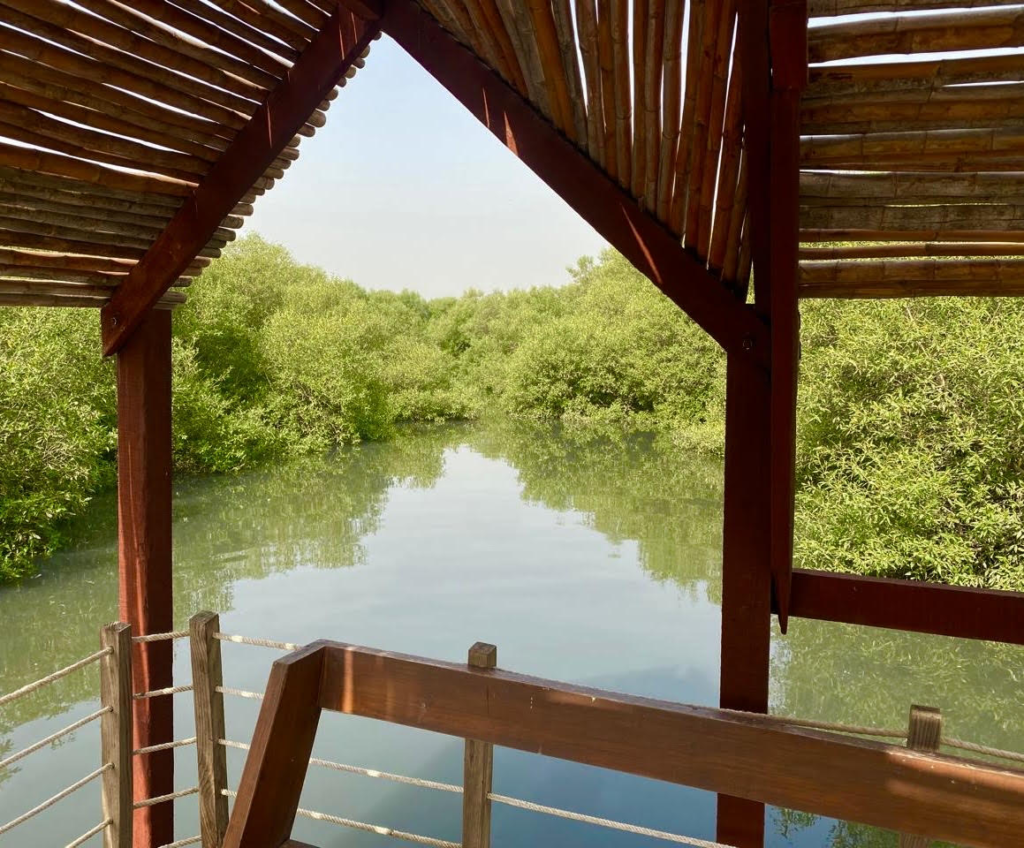
The design of the park includes a floating boardwalk which rises and falls with the tide and winds through the mangrove ecosystem. The nature walk is an immersive experience, with salt water and mangroves on either side. In the early hours of the morning, visitors may be able to spot native birds like kingfishers and egrets, as well as other species like mongoose and certain types of fish. “When the tide goes down, the roots and mudflat which lie below the water are visible,” said Jahansher, talking about how the park is an entirely different experience depending on the tide and time of day which one visits. During the high tide, visitors can walk through the floating mangrove forest, right above sea level. During the low tide, the boardwalk descends, revealing the world that exists under the water.
TPL Developments is also building an apartment complex in close proximity to the park. Measures are being taken to offset the environmental impact of the development project on the surrounding environment. “TPL has established an independent board of experts from industry, academia, and the Sindh Forest Department to oversee the Mangrove Biodiversity Park, ensuring conservation remains central to its mission,” said Rizwan Karim, CEO of TPL Developments. “The development plan prioritizes protection of the existing ecosystem, with buildings designed for green certifications like LEED and EDGE, and a buffer zone separating structures from mangroves,” he said. It is crucial for development schemes to have systems in place to curb or prevent any negative outcomes for the surrounding ecology. “Wastewater systems ensure zero discharge, while low-impact features such as floating walkways and eco-friendly materials minimize disturbance. Residential and recreational spaces are integrated to let visitors experience nature without harming it, and landscaping relies on native plants to boost biodiversity and long-term resilience,” said Karim.
Despite these efforts, concerns still linger. “There should ideally be at least a half kilometer buffer zone between the coastline and human settlements”, said Rafi ul Haq, Pakistan’s former national coordinator for the Mangrove for the Future programme and the IUCN. He is a plant ecologist with decades of experience in biodiversity conservation. “When a tsunami strikes, mangroves act as a crucial natural barrier that helps reduce its destructive impact.” This is especially concerning given how close the apartment complex and industrial area are to the coast. The Korangi industrial area nearby is a major polluting force, which likely nullifies any sustainable measures undertaken by development projects in the area.
Awareness surrounding the proper conditions for mangroves and their importance for the coastal ecosystem is still severely lacking. “Education and understanding that mangroves grow in intertidal zones. The groups that are planting need to understand that planting in terrestrial parks and watering with sweet water is not a mangrove restoration project,” said Qaiser. “Planting on a river flood plain is not a viable place for a mangrove restoration project. There are other plants and trees that will grow there, not Mangroves as they require intertidal land that floods with brackish sea water twice a day” he added. If Karachi’s natural environment is to be restored, randomly planting trees is not going to cut it.
The construction of this park was not simple, especially given the degree to which the coastal environment has been damaged. “From trying to rehabilitate a neglected ecosystem to navigating a challenging environment and convincing stakeholders, there have been several challenges, but thankfully we have addressed them,” said Aliani. “The challenges now are to educate visitors to respect the space, abide by the guidelines that are in place and enhance the facility. We must bring more mangroves under conservation, we need more organisations to take ownership and sponsor further expansion.” he said.
Satellite imagery from Google Earth reveals a perfectly symmetrical coastline, suggesting that the area is reclaimed land. Over the past 15-25 years, the density and spread of mangroves has declined, while industrialisation has steadily expanded, as shown in the comparative images. Roads, urban development and land reclamation has caused habitat fragmentation on a very large scale.
Mangroves protect coastlines from erosion and storm surges, acting as natural barriers against flooding. They absorb and store large amounts of carbon dioxide, making them powerful tools in the fight against climate change. They also provide vital breeding grounds for fish, crabs, and countless other marine species, making them an integral component of any shoreline habitat. “Mangroves are a vital part of the coastal ecosystem, yet builders often view this land as an opportunity for development” said Rafi. “Profit-driven motives can easily be given a cosmetic look.”
“Children are the key for the future. Therefore I feel the desperate need to have as many of these eco learning centres available and accessible for all” said Qaiser. “It is imperative that we push for the creation of nature reserves on our islands and the Indus River delta,” he added. Today, Karachi’s coastal habitats are on the verge of no return from years of pollution, mismanagement and neglect. Those speaking up or taking measures to combat this are few and far in between. To let the urgency of the matter sink in, Qaiser offered an impactful statement. “If we as citizens do not speak up and object about this callous disregard for our own and our environmental health then the onus is on us”.

- Rat Race - August 2, 2026
- Inside Korangi’s Mangrove Biodiversity Park - July 23, 2026
- KMC Zoo Under Fire - July 19, 2026